Policy Shifts & Practice Realities for U.S. Occupational Therapy Clinicians
Newsletter 2 | December 7th, 2025
Our goal is to provide occupational therapy clinicians with clear, concise updates on policy changes, payer trends, and workforce factors that may influence clinical practice across settings. This issue summarizes key elements of the CY 2026 Medicare Part B Final Rule, as well as notable developments in student loan policy and private insurance authorization trends that may affect the profession over the coming years.
This newsletter is designed to give clinicians:
-
A brief overview of what has changed
-
Practical implications to be aware of
-
A grounded understanding of how these shifts may be experienced in day-to-day practice
1. Conversion Factor Increase (First Raise Since 2019)
What CMS Says / Policy Summary
The Medicare Conversion Factor (CF) increases to 33.4009 in 2026 (+3.26%).
This results in a modest reimbursement increase for many OT CPT codes.
Congress added a temporary bump to stabilize payment for 2026.
Practical Impact
-
Most OT codes tied to the MPFS will see a small increase.
-
The increase helps offset reductions elsewhere (efficiency adjustment, PE cuts, etc.).
-
OT hasn’t seen an upward movement since 2019, so this is framed as a historic positive.
-
Stabilizes Part B outpatient OT payment for the year.
Clinician Reality
Most OTs will not feel this raise at all.
Why?
-
Over 50% of older adults are now enrolled in Medicare Advantage, not traditional Medicare Part B.
-
Medicare Advantage plans do NOT have to adopt Medicare’s payment rates — and they usually don't.
-
Commercial insurance companies (BCBS, UHC, Aetna, Cigna, etc.) also do not mirror CMS increases.
-
Many clinics negotiate contracts that bake in multiyear flat rates, meaning no raise regardless of federal changes.
-
Productivity demands, visit caps, and utilization management will likely tighten, not loosen.
2. OT Telehealth Codes Made Permanent
What CMS Says / Policy Summary
CMS eliminated the old “provisional vs. permanent” distinction for telehealth CPT codes.
Now the only criterion is whether a service can be safely delivered via real-time, two-way audio/visual.
Result:
All OT telehealth codes currently on the Medicare list are now permanent.
Practical Impact
-
OT no longer has to wait each year to see if telehealth codes stay or disappear.
-
Long-term stability for hybrid or remote-service models.
-
Easier pathway to add future telehealth codes (research burden reduced).
-
Protects patient continuity of care and supports more flexible service delivery models.
Clinician Reality
Here’s the truth: this doesn’t guarantee you can bill telehealth.
Why?
-
Medicare Advantage and commercial payers can still deny telehealth for OT, regardless of CMS’s stance.
-
Many large insurers routinely:
-
Exclude OT from telehealth
-
Allow it only for specific diagnoses
-
Require special contracts or modifiers
-
Reimburse telehealth at lower rates
-
-
Some states have telehealth parity laws — but many do not.
-
Employers may still prohibit telehealth because of:
-
Productivity expectations
-
Clinic revenue models
-
Compliance concerns
-
Internal policy barriers
-
3. Efficiency Adjustment (EA) – Quiet Cuts to “Untimed” Codes
What CMS Says / Policy Summary
CMS believes many untimed CPT codes overestimate how long services actually take due to “efficiency gains” (better tech, workflows, experience).
So, for CY 2026, CMS finalized:
-
A –2.5% reduction to work RVUs for a large set of applicable untimed codes (the “Efficiency Adjustment”).
-
Exceptions list that is not subject to the cut, including:
-
Time-based services
-
E/M services
-
Behavioral health services
-
Telehealth list codes
-
Initially, CMS had mistakenly included some time-based OT codes in the EA.
After advocacy, CMS:
-
Removed those OT time-based codes, and
-
Excluded RTM codes from the adjustment.
In the final rule, only a small number of supervised modalities & wound care codes commonly used by OT are affected.
Practical Impact
-
OT largely avoided broad EA cuts thanks to strong advocacy.
-
The rule affects only a limited slice of OT services.
-
AOTA is watching closely to prevent further erosion and to push for proper valuation.
Clinician Reality
This one’s dangerous precisely because it looks small.
What’s really happening:
-
CMS continues to chip away at therapy code values over time:
-
Multiple Procedure Payment Reduction (MPPR)
-
OTA modifier differential cuts
-
Practice expense cuts (like the eval supply pack reduction)
-
And now the Efficiency Adjustment on select services
-
-
Even if only a few OT codes are hit now, EA is a policy precedent:
-
CMS is basically saying:
“We think you should be faster now, so we’re paying you less per unit of work.”
-
-
These small technical cuts often do not show up clearly to clinicians:
-
Employers don’t itemize, they just say:
-
“Reimbursement is tight.”
-
“We can’t raise wages.”
-
“We need higher productivity.”
-
-
So while this year’s direct impact on OT is small, the pattern is:
Tiny, repeated cuts at the code and practice-expense level →
Flat or falling reimbursement →
Rising productivity expectations and burnout.
4. KX Modifier & Medical Review (MR) Thresholds
What CMS Says / Policy Summary
For CY 2026, therapy thresholds are:
-
KX Modifier Threshold – OT:
-
$2,480 for occupational therapy services
-
-
KX Modifier Threshold – PT/SLP combined:
-
$2,480 total for physical therapy + speech-language pathology
-
Once claims for a patient’s OT services exceed $2,480, therapists must:
-
Append the KX modifier
-
Confirm that services remain medically necessary
-
Ensure documentation clearly supports ongoing skilled care
CMS also maintains a Medical Review (MR) threshold:
-
MR threshold remains $3,000 through CY 2027
-
Beginning CY 2028, it will be updated annually using the Medicare Economic Index (MEI)
Exceeding the MR threshold does not automatically deny payment, but:
-
It signals that claims may be subject to targeted review based on:
-
Denial history
-
Aberrant billing patterns
-
Newly enrolled providers
-
Certain diagnoses
-
Association with groups flagged for questionable practices
-
Practical Impact
-
KX and MR thresholds help CMS monitor high-utilization cases without hard caps.
-
AOTA emphasizes:
-
The importance of thorough documentation above the KX threshold
-
Understanding that the MR threshold signals potential audits, not automatic denials
-
-
AOTA continues to advocate against “hard caps” while supporting clinically justified care based on individual need.
Clinician Reality
For clinicians, the KX and MR thresholds are basically:
“The point where everyone starts to get nervous.”
KX Threshold = Invisible Pressure Point
Even though:
-
KX simply means:
“I certify this is still medically necessary.”
In practice, many clinicians experience:
-
Managers saying things like:
-
“We really try not to go over KX unless absolutely necessary.”
-
“Can you discharge soon? They’re getting close to their cap.”
-
-
Subtle or explicit pressure to:
-
Discharge earlier than clinically ideal
-
Space out visits
-
Switch to “maintenance” or HEP-only even if the patient still needs skilled input
-
So even though there’s no hard cap, the culture around KX often acts like there is one.
MR Threshold = Audit Fear, Whether or Not Review Actually Happens
Most therapists rarely see an audit personally, but:
-
Administrators understand that claims above $3,000 come with higher scrutiny potential.
-
That fear trickles down as:
-
“We don’t want to be on CMS’s radar.”
-
“Let’s avoid going that high unless it’s a must.”
-
This can lead to:
-
Clinicians second-guessing legitimate care
-
Over-focus on minute-counting instead of functional outcomes
-
A sense that:
“If someone needs a lot of therapy, they’re now a risk to us.”
Complex Patients Are Quietly Disincentivized
The people most likely to cross KX + MR thresholds are:
-
Stroke survivors with dense deficits
-
Progressive neurodegenerative conditions
-
Multi-trauma clients
-
Complex geriatric cases
-
Individuals with cognitive + physical + psychosocial overlay
In other words:
Exactly the people OT is uniquely good at helping.
But KX/MR culture creates an environment where:
-
Clinics may avoid or limit high-need patients
-
Clinicians are subtly discouraged from:
-
Prolonged, intensive, occupation-based care
-
Long-term functional maintenance programs
-
-
Instead, the system pushes:
-
Shorter episodes
-
Quick “functional” wins
-
Low-risk, low-volume cases
-
5. OBBA Professional Degree Status & Student Loan Caps
What the Policy Says
The One Big Beautiful Bill Act (OBBBA) restructures federal student loans starting July 1, 2026:
-
Graduate programs now have lower federal borrowing limits (≈$20,500/year; ≈$100k lifetime).
-
Professional degree programs (medicine, dentistry, law) have higher borrowing limits (≈$50k/year; ≈$200k lifetime).
-
Occupational therapy programs are not currently classified as “professional”, meaning OT students fall under the lower cap.
-
Grad PLUS loans — which previously filled the gap — are eliminated.
OT, PT, SLP, nursing, social work, PA programs are all affected unless regulations change.
Practical Impact
-
The cost of OT school (often $80k–$150k+) will exceed federal loan caps for many students.
-
OT programs are warning future applicants about funding gaps.
-
AOTA and others are aggressively pushing the Department of Ed to officially classify OT as a professional degree, restoring access to higher borrowing limits.
Clinician Reality
This doesn’t hit your clinic tomorrow — but it absolutely hits your future:
1. Shrinking Pipeline
If students can’t borrow enough to cover tuition:
-
Fewer people will enter OT school.
-
Programs may shrink cohorts or close.
-
Fieldwork sites will see fewer students.
-
Rural and underserved areas — already OT deserts — become worse.
2. Delayed Impact, But Guaranteed Impact
It won’t change your Monday schedule next week.
But in 3–7 years, the pipeline of new graduates may tighten dramatically, leading to:
-
Fewer applicants for OT jobs
-
Higher burnout for existing clinicians
-
More pressure to do more with less
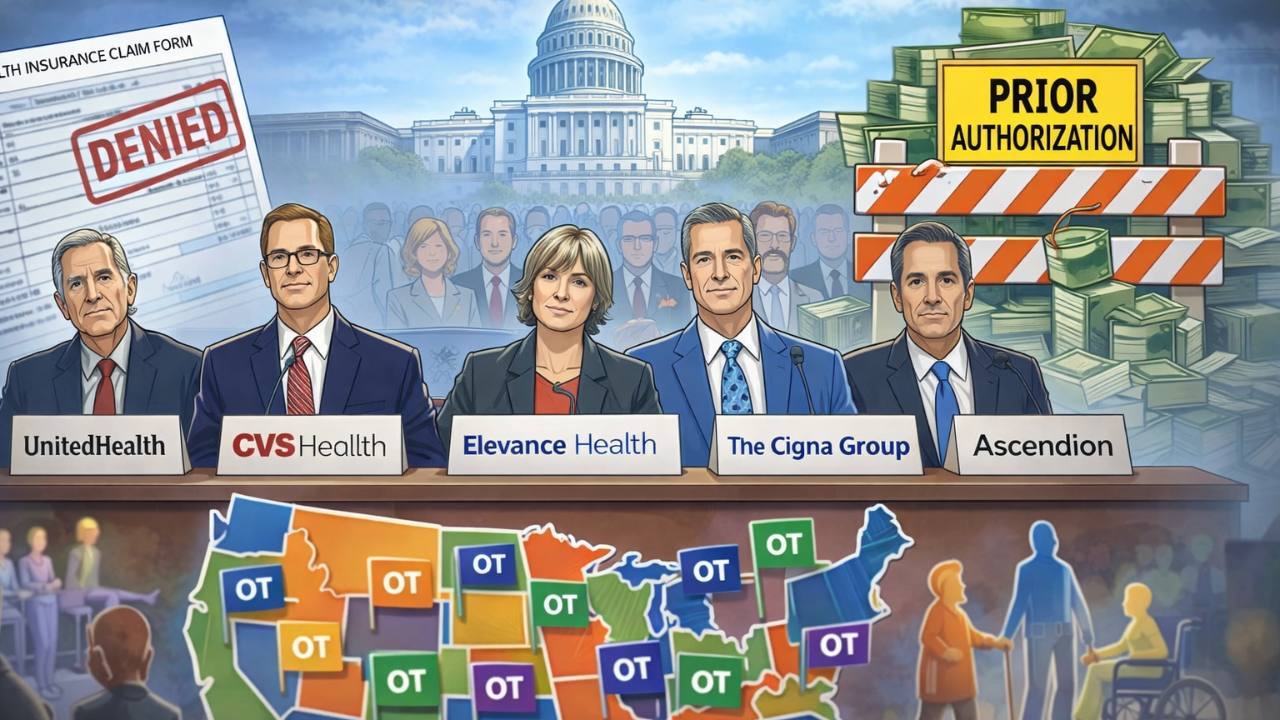
6. Private Insurance Trends: Prior Auth, Visit Caps & Therapy Restrictions
What the Market Says
Private health insurance — including Medicare Advantage (MA) — is increasingly:
-
Expanding prior authorization requirements
-
Tightening visit limits
-
Requiring more frequent progress reports
-
Using third-party utilization management (eviCore, NaviHealth, AIM, Magellan)
-
Cutting reimbursement rates or holding them flat for years
Across the country, payers are shifting toward cost-containment models, explicitly targeting rehab services.
Practical Impact
-
More OT practitioners must justify every visit in detail.
-
Clinics spend more nonbillable time appealing denials or writing reports.
-
Providers are pushed to use:
-
Shorter episodes of care
-
Lower frequency
-
“Prove improvement every visit” standards
-
-
MA plans now cover more than 50% of older adults, amplifying this trend nationally.
Clinician Reality
1. Prior Auth Is Becoming “Soft Utilization Denial”
Many prior authorizations are a barrier to patient care delivery in a reasonable time:
-
Long wait times
-
Repeated “more information needed” requests
-
Delays that cause patients to miss the window for skilled intervention
-
Approved visits far below clinical need (e.g., 4–6 visits for complex neuro cases)
2. More Documentation → Same Pay
Therapists are writing:
-
Longer justifications
-
More progress updates
-
Detailed functional metrics
-
Appeal letters
All while:
-
Productivity stays the same or rises
-
Pay does not increase
-
Nonbillable admin time goes unrecognized
This is one driver of therapist burnout nationwide.
3. Medicare Advantage Is Driving the Trend
MA plans reimburse lower than traditional Medicare Part B but require:
-
More documentation
-
More denials
-
More administrative burden
-
More prior auth
-
More visit caps
Clinicians feel this daily — regardless of CMS’s “good news.”
As we enter 2026, clinicians can expect continued changes across Medicare policy, private payer requirements, and the higher-education landscape. Some updates bring increased stability, others introduce new administrative considerations, and some may impact the future OT workforce over time.
The U.S. Occupational Therapy Clinician Coalition will continue to monitor these developments and summarize the information most relevant to practicing clinicians, helping the profession stay informed and prepared.
Thank you for your ongoing commitment to high-quality, evidence-based, occupation-centered care. We hope this newsletter supports you in navigating a healthcare system that continues to evolve in both meaningful and complex ways.
Next Steps:
As the U.S. Occupational Therapy Clinician Coalition (OTCC) continues to take shape, we welcome your involvement in helping define its priorities, structure, and areas of focus. Our goal is to build a clinician-centered coalition that reflects the needs, challenges, and opportunities experienced across all practice settings and all regions of the country.
We invite you to contribute in the following ways:
1. Share What Matters Most to You as a Clinician
We want to understand the issues that directly affect your daily work.
Your perspective will help guide the coalition’s early projects, policy monitoring, and resource development.
You are encouraged to provide input on:
-
Key challenges in your setting
-
Areas where you see gaps in support or representation
-
Topics you would like OTCC to track, analyze, or communicate about
2. Help Shape OTCC’s Service and Support Areas
We are gathering feedback on where clinicians feel a coalition can be most useful — including professional updates, payer trends, state-level policy tracking, advocacy tools, education, and community-building.
3. Consider Joining a Leadership or Support Role
If you are interested in contributing more directly, we are seeking clinicians for the following roles as the structure of the coalition develops:
-
Secretary
Responsible for note-taking during meetings, organizing agendas, and assisting with newsletter distribution. -
News & Current Events Coordinator
Monitors major developments in occupational therapy, healthcare policy, and payer trends, and communicates updates to coalition leadership for processing and reporting. -
State Representatives
One clinician (or two clinicians, if there are individuals who want to step up as a team!) from each state who can:-
Track issues affecting clinicians locally
-
Serve as a point of contact for state-level updates
-
Facilitate small task groups or discussions within that state
-
Report emerging topics or legislative developments relevant to practice
-
These roles are flexible and will evolve as the coalition grows. Time commitments will be clearly outlined, and support will be provided.
Please contact us with any questions via instagram @USOTCC or email us at [email protected].